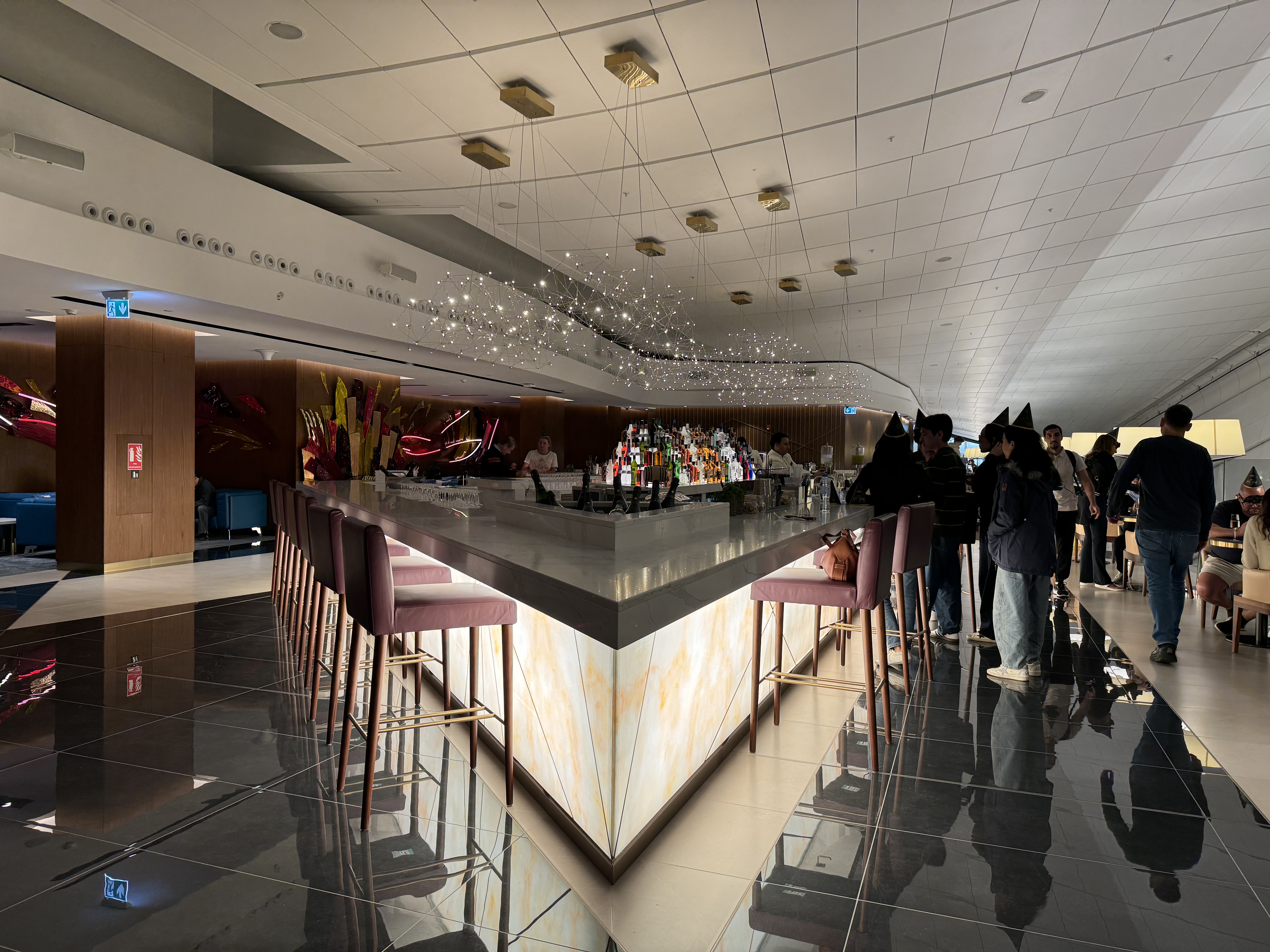
The new Etihad Airways Business Class Lounge at Abu Dhabi’s Zayed International Airport is a substantial improvement on the airline’s previous facility. Spread across three levels, it offers more room, stronger food options and far better shower facilities than the lounge it replaced.
I visited after leaving my former role with Etihad Airways and paid separately for access. From the moment I walked in, the change that stood out most was simple: space. Abu Dhabi competes in a region packed with strong airport products, so this lounge needs to hold its own against some demanding rivals.
Does the extra space make a real difference?
The lounge stretches across three floors in a long, narrow layout. That shape has advantages and drawbacks. The positive is obvious. Even during busier periods, there appears to be ample capacity. Crowding, which was one of the defining features of the older lounge, feels far less likely here.


The downside is navigation. I found the wayfinding weaker than it should be. Guests tend to gather around the main dining zone on the lower level or around the upper floor bar, leaving some sections noticeably quieter.


A good example involves the shower facilities. One shower area had a queue, while another facility only a short walk away sat largely unused. The issue was not availability but awareness. Better signs would solve much of that problem.


The long footprint brings another benefit. During daylight hours, natural light reaches much of the lounge. Combined with a brighter design scheme, the overall atmosphere feels lighter than the darker styling found in the previous generation of Etihad lounges.
Is there enough seating for different types of travellers?
Choice is one of the strongest aspects of the lounge. I spent most of my visit in the sofa style seating, but there were also numerous dining tables for pairs and small groups spread throughout the facility.


Solo travellers are not ignored either. Individual seating areas are scattered around the lounge, offering a little more privacy for those wanting a quieter environment. I would still like to see more high backed chairs suitable for longer periods of work, but the variety already exceeds many competing business class lounges.
Power provision is generally good. USB A connections are available across much of the lounge, making it easy to keep devices charged. That said, I was surprised by the absence of USB C ports. Given how established that standard has become, their omission feels dated in a lounge that opened at the end of 2023.

Family travellers are also catered for through a dedicated family area. It helps separate different travel styles without forcing everyone into the same shared spaces.


Have the shower facilities improved?
Without question, yes.
The old Terminal 3 lounge suffered from ventilation problems. Even a brief shower could leave the room feeling uncomfortably warm. That issue appears to have been addressed.


I found the new shower suites well designed. The marble effect finish will not appeal to everybody, but the lighting was effective, the airflow worked properly and the water pressure remained consistently strong. Those basics matter more than decorative flourishes.


The one area where Etihad could push further is the amenity selection. Higher quality branded products would add another layer of polish.
The accompanying washrooms continue the same design language and were maintained to a high standard throughout my visit.
How good are the food and drink options?
The main dining area is called Liwan Global Dining and sits on the ground floor. In practical terms, it operates as a buffet supported by several live cooking stations.


The food selection impressed me. There is a noticeable influence from South Asian cuisine, although the range extends beyond that with local Emirati dishes included. The variety felt broader than some competing lounges in Abu Dhabi.

More importantly, the food tasted good. Airport lounges often focus on quantity ahead of quality. Here, the balance was better managed. I would place the dining experience slightly behind Qatar Airways’ Al Mourjan Lounge in Doha, but the gap is not enormous.

What I enjoyed most was the atmosphere within the dining space. It carried elements of Abu Dhabi’s identity rather than feeling completely generic (a common problem in modern airport lounges).


At the centre of the room sits a bar serving a range of drinks, including the airline’s lemon mint beverage. That remains one of my favourite non alcoholic airport drinks.


On the top floor, passengers will find another buffet alongside the lounge’s most visually striking feature, a central bar. It is an attractive space and naturally draws people towards it.
The spirits selection covers the main categories and includes labels such as The Botanist gin. Even so, the premium end of the range does not feel especially extensive. Business class passengers expecting an ultra luxury selection may leave with a different view of the offering.
During my visit, two different Champagnes were available, Duval Leroy and Devaux Grand Réserve. Both were enjoyable, though I am hardly an authority on wine.

Coffee can be ordered from staffed bar areas or collected from self service machines positioned throughout the lounge. Nearby snack stations include canned soft drinks and premium crisps, including truffle flavoured varieties that proved surprisingly difficult to stop eating.


Is lounge boarding actually useful?
The lounge connects directly to selected departure gates, allowing eligible passengers to board from within the facility. That arrangement is not available for every flight, so it is worth checking with lounge staff after arrival.
In general, Airbus A380 services are the most likely to benefit because their gate positions sit close to the lounge infrastructure. Other departures depend on operational requirements.


I have mixed feelings about this feature. On paper it sounds attractive. In practice, passengers often begin gathering around the boarding points long before boarding starts.
That behaviour creates congestion and chips away at the relaxed atmosphere elsewhere in the lounge. Yet there is still value in avoiding a separate trip to a distant gate. The concept works. The execution remains a little untidy.
The overall result is a lounge that corrects many weaknesses from the previous era. The food is strong, the showers are dramatically better and the amount of space changes the experience for the better. Poor signage remains an annoyance, but it is hardly a deal breaker.

I would happily use this lounge again. It does not surpass the finest hub lounges operated by carriers such as Qatar Airways or Cathay Pacific, yet it no longer feels outclassed by them. Access through a Business Class ticket makes perfect sense. Paying AED 490 for four hours in Economy is another matter entirely. However pleasant the experience may be, that price asks too much.
Adapted from my article originally published on Turning Left for Less.
Leave a Reply