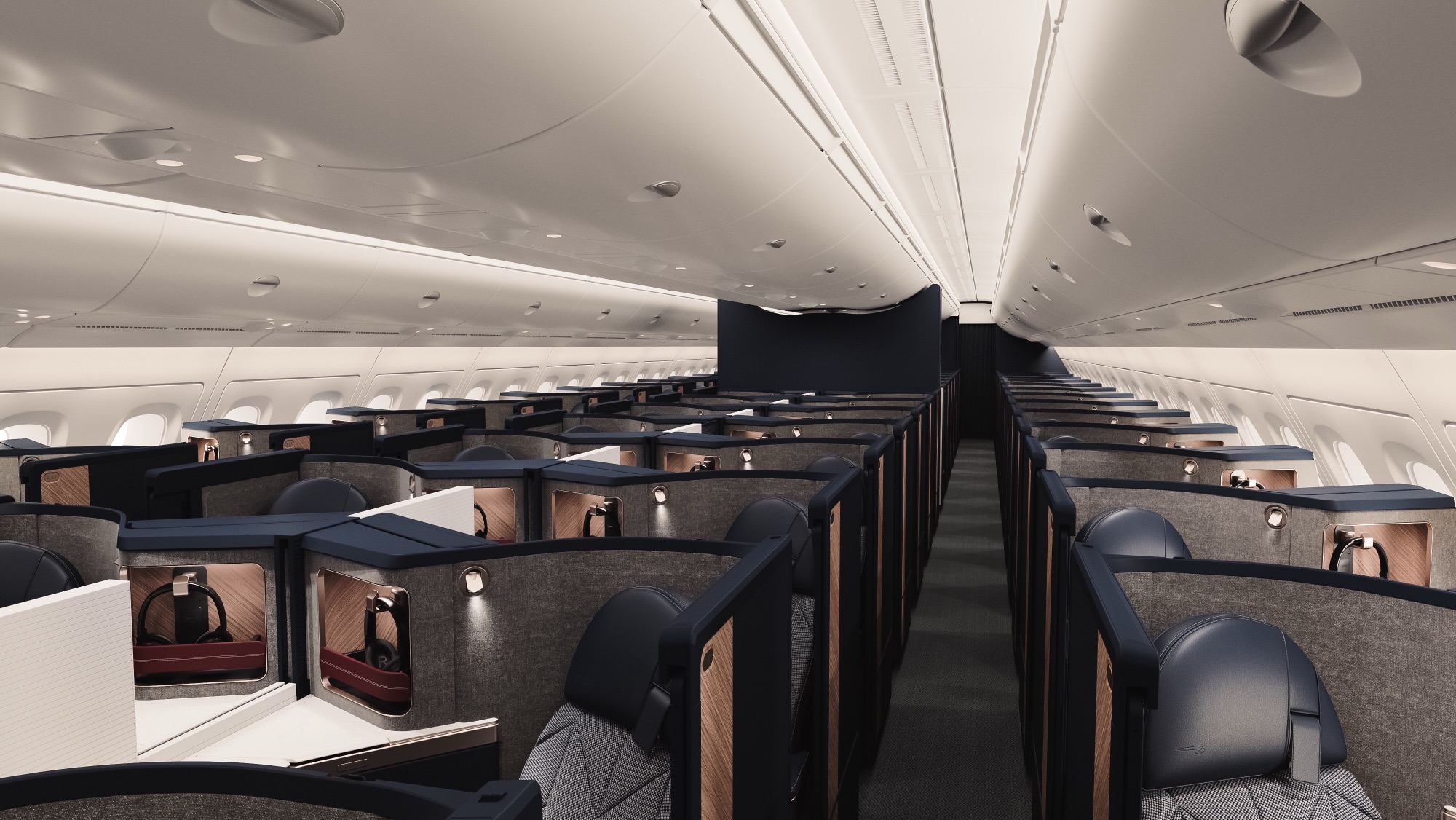
British Airways will remove 88 World Traveller seats from each of its 12 Airbus A380s as part of a retrofit that reduces total capacity from 469 to 421 passengers. The entire upper deck becomes a 106-seat Club World cabin, which the airline says will be the largest dedicated business class cabin on any commercial aircraft (Travel Weekly, 2026). The first retrofitted aircraft is expected to enter service in the coming months.

I have followed this retrofit programme since British Airways first teased the new First suite in 2024. The final seat map confirms what the airline has been signalling for two years: this is a full rethinking of the A380 around premium demand. The product details that landed alongside the announcement are more revealing than the seat counts, because they show where British Airways thinks the money is.
What does the new First cabin actually deliver?
The new First suite is the centrepiece. Twelve seats instead of fourteen, each with a sliding door, a stowable table for buddy dining, and a divider that opens between centre seats to create a shared lounge. The seat was designed and built by manufacturers across Great Britain and Ireland, and the cabin is meant to feel like a modern luxury hotel rather than an airline seat (Business Travel News, 2026).
The soft product is where British Airways has spent real money. The Swaine amenity kit, available from 6th October, is a unisex design inspired by the heritage suitcases carried by early air travellers, offered in royal blue and cream. Inside are six Wildsmith formulations, including a face mist, hand and body lotion, ceramide multi balm, lip balm, face cream, and an overnight mask built around a Circadian Rhythm concept for hydration at altitude. The sleepwear is navy cool-touch fabric with the airline’s bespoke tartan, and the bedding includes a luxury mattress, lightweight cotton duvet, and a newly designed pillow. A mini bar is integrated into the seat with premium snacks and still and sparkling water.

The dining programme is the other significant shift. The new First service, available across the long-haul fleet from 1st October, introduces a From the Grill concept where passengers build a meal from British roast rack of lamb, grilled salmon, sides and sauces, alongside Signature Mains. The tableware is stoneware and fine bone china, the cutlery is by Studio William, and the wine glasses were developed with Richard Brendon and Jancis Robinson. Bollinger La Grande Année leads the Champagne list, and there is a curated gin selection including a 0.0 per cent option. First Service Specialist cabin crew, trained through a new programme, deliver the service.
How does Club World fit into the premium push?
The Club Suite on the A380 is an evolution of the seat already flying on the A350 and many 777s and 787s. It is a reverse-herringbone layout with a sliding privacy door, and it corrects the awkwardness of the old yin-yang Club World seat where some passengers had to step over a neighbour to reach the aisle (Simple Flying, 2026). The A380 version adds storage, improved functionality, and a colour palette drawn from the airline’s blue, red, and cream accents.

What matters is the scale. One hundred and six suites across the full upper deck, split into four zones with dedicated dwell areas and Club Kitchens. No other A380 operator has dedicated an entire upper deck to business class at this density. Emirates has spent $5 billion retrofitting 219 aircraft with a premium focus, but its A380 business class remains on the main deck alongside First (Emirates, 2026). British Airways is doing something different: it is treating the upper deck as a premium-only zone.

The Club World amenity kits come in four designs created by British artists through the Rise Art platform, stocked with products from anatomé. That is a smaller investment than the First kit, but it signals the same intent. British Airways wants Club World to feel like a distinct product rather than a diluted version of First.

Is the premium bet too late or right on time?
International premium-class travel reached 109.7 million passengers in 2025, up 4.5 per cent year on year, according to the International Air Transport Association (IATA, 2026). Premium cabins are driving a disproportionate share of revenue across the industry, and British Airways is not alone in reallocating floor space. The sceptical case is straightforward: premium demand has been strong for three years, but airline profitability remains sensitive to economic shocks, and a downturn in corporate travel spending would leave British Airways with twelve aircraft configured for a market that has softened. First shrinks from fourteen to twelve seats, which suggests the airline is not entirely convinced the top cabin will fill consistently.

World Traveller Plus grows from 55 to 84 seats, and that is where the volume play sits. Business travellers whose employers have tightened long-haul policies are more likely to book premium economy than Club World. British Airways is positioning for that middle ground while keeping First as a halo product. The new World Traveller Plus amenity kit is a reusable tote bag with a Dr.PAWPAW balm and travel essentials, and the seat has larger screens and privacy wings. It is not First, but it is a clear step up from economy.

Sean Doyle, the airline’s chairman and chief executive, described the retrofit as one of the most significant transformations British Airways has ever undertaken on any aircraft, and framed the investment as going far beyond a single cabin (Travel Weekly, 2026).
The Heathrow lounge transformation is the part of the investment that will touch the most passengers. British Airways has confirmed a new lounge at Terminal 5 C Gates and a redeveloped arrivals lounge, with every Heathrow lounge scheduled for redesign over the coming years (Business Travel News, 2026).


Every long-haul premium traveller will have the chance to travel through a lounge regardless of cabin, while only a fraction will sit in the new First suite. Wildsmith amenities will appear in the Concorde Room, First, and Club lounges over the coming months, which extends the premium product beyond the aircraft.
The retrofit will take until at least 2028 to complete across all twelve aircraft (Reward Flight Finder, 2025). British Airways has cut A380 flying by around 28 per cent for winter 2026/2027, reducing the type to four routes while aircraft cycle through the programme (Aerospace Global News, 2026). Passengers booked on routes that previously saw the A380, including Los Angeles and Johannesburg, will find Boeing 777s or other equipment instead.

The premium product is the strongest part of this announcement. The First suite, the Swaine kit, the Wildsmith formulations, the dining programme, and the lounge investment all point in the same direction, and they are backed by a genuine understanding of what premium passengers want at altitude. My concern is not the product. It is the timeline. British Airways is asking passengers to trust a premium promise that most will not be consistently experienced for another two years, and the airline has not yet shown it can retrofit aircraft on schedule. The premium bet is defensible on the data. The execution is the risk, and British Airways has a long history of letting premium product launches overrun its capacity to deliver them.
Leave a Reply