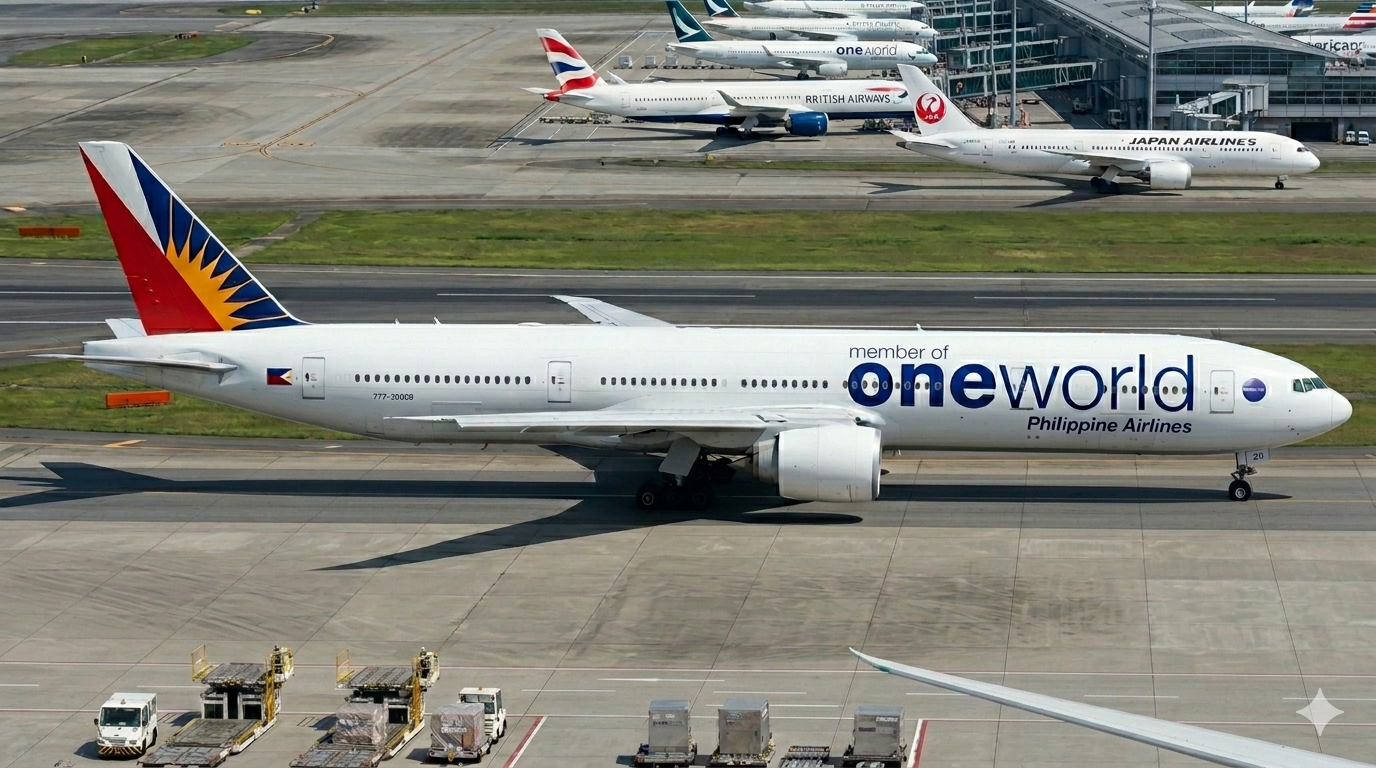
Philippine Airlines (PAL) has accepted an invitation to join the oneworld Alliance, becoming the 16th full member and only the second Southeast Asian carrier in the group after Malaysia Airlines. The announcement came on 6th June 2026 at the IATA Annual General Meeting in Rio de Janeiro (Aviacionline, 2026). For passengers, the headline benefit is clear: Mabuhay Miles members will soon earn and redeem points across oneworld’s 15 existing airlines, gaining access to more than 700 premium lounges worldwide (Economic Times, 2025). That is a genuine step up for a carrier that has operated as a network outlier for years.

I have followed PAL’s ups and downs closely, and this invitation did not come out of thin air. The airline has been quietly rebuilding after its 2021 Chapter 11 restructuring, which saw ANA’s original 9.75% stake diluted to 4.75% (ch-aviation, 2024) The press release notes PAL’s 85th anniversary this year, and the carrier recently earned an APEX Four Star rating plus Cirium’s award for highest on‑time performance among Asia‑Pacific carriers in 2025, achieving an 83.12% on-time arrival rate (Philippine Airlines, 2026). That is not the balance sheet of a carrier scrambling for a lifeline. It is the work of an airline that has earned its seat at the table.
What does this mean for passengers flying from Manila or Cebu?
The practical gains for travellers are real, but they are not instant. PAL’s domestic network of 29 destinations and its international reach across 40 cities in Asia, North America, Australia and the Middle East will now plug directly into oneworld’s route map of nearly 1,000 destinations (Aviacionline, 2026). For a frequent flyer based in Manila, that means connecting onto a Qatar Airways flight to Doha or a British Airways service to London without the baggage re‑check headaches that come with flying unaffiliated carriers. Top‑tier Mabuhay Miles members will also receive oneworld Priority privileges, including access to first‑class lounges and dedicated check‑in areas where available.

But here is the catch. Full integration takes time. (The last full member to join, Royal Air Maroc in 2020, took over 18 months to complete its integration process and implement full loyalty earning and redemption across the alliance (TravelPulse, 2018) PAL has not announced a target date for completion, and the press release is notably light on milestones. For now, the invitation is a memorandum of understanding, not a switch that flicks on overnight.
Why did oneworld invite PAL, and what does the alliance gain?

Oneworld has long had a blind spot in Southeast Asia. With only Malaysia Airlines as a full member in the subregion, the alliance has watched Star Alliance (Singapore Airlines, Thai Airways) and SkyTeam (Vietnam Airlines, Garuda Indonesia) build deeper networks. PAL brings 31 unique domestic destinations that no other oneworld carrier serves, plus a growing long‑haul franchise to the US West Coast and Canada (Luchtvaartnieuws, 2026). Robert Isom, CEO of American Airlines and chair of the oneworld Governing Board, said in the announcement that PAL’s entry supports the alliance’s long‑term strategic growth and strengthens connectivity across key Asia‑Pacific markets.
PAL’s entry into oneworld supports our long‑term strategic growth and strengthens our connectivity across key markets in the Asia Pacific region. (Isom, 2026)
There is also a symbolic element. PAL is Asia’s first commercial airline, founded in 1941, and it has just clocked 85 years of operations. Bringing a carrier with that heritage into the fold sends a message about oneworld’s appetite for established, full‑service carriers rather than chasing every regional upstart. And here is a twist: ANA, a core Star Alliance member, owns 4.75% of PAL. Yet PAL is walking into oneworld’s arms. That tells you something about how little equity stakes matter when an airline needs network reach (ch-aviation, 2024). That said, I am not convinced this move alone reshapes the competitive landscape. Cebu Pacific, PAL’s low‑cost domestic rival, continues to eat into its market share at home. Alliance membership does not fix a home market disadvantage.

There is also a timing clue that the press release glosses over. Just weeks before this oneworld invitation, PAL signed a major codeshare with Qatar Airways effective 1st June 2026, unlocking over 20 European destinations for Manila passengers via Doha (Qatar Airways, 2026). And in late May, PAL expanded its frequent flyer tie‑up with Qantas, giving Qantas Frequent Flyers access to 15 Philippine island destinations like Boracay and Palawan (Qantas, 2026). Both Qatar and Qantas are oneworld members. Both deals effectively let PAL behave as if it were already inside the alliance, earning and redeeming points across their networks. I wrote last month about how you could already spend British Airways Avios on PAL flights, kind of – the infrastructure has been quietly assembling for months. So this invitation is not a bolt from the blue. It is the formal handshake after months of back‑room partnership building, and it makes me wonder which other oneworld carriers have been warming up behind the scenes.

What could go wrong with PAL’s oneworld integration?
Integration risk is real. PAL’s on‑time performance has improved dramatically, hitting 83.12% in 2025 to become the most punctual airline in Asia‑Pacific according to the press release’s citation of Cirium (Philippine Airlines, 2026). That is a remarkable turnaround from the “Plane Always Late” reputation of previous years (Inquirer, 2026). But maintaining that punctuality while aligning schedules, baggage systems and IT platforms with 15 other airlines is a different challenge. Oneworld CEO Ole Orvér praised PAL’s “strong commitment to innovation and customer service”, but innovation is not the same as execution.

There is also the question of fleet commonality. The press release does not detail PAL’s order book, but airlines entering alliances often face delays if new aircraft deliveries slip. I have seen too many alliance announcements end in a whimper rather than a bang, with years of “we are working on it” updates. PAL’s leadership has earned the benefit of the doubt, but it has not yet earned a pass.
Philippine Airlines has pulled off something genuinely difficult: it survived Chapter 11, cleaned up its operations, and convinced a global alliance to bet on it. That is the story the press release wants to tell, and it is mostly true. But the real work begins now. Integration is where alliances either deliver or disappoint, and PAL’s passengers will know within 18 months whether this is a transformative partnership or just a nice logo on the tail fin. I think it will be the former, but I am watching the schedule integration like a hawk.

I covered Philippine Airlines extensively here and on YouTube, here’s a selection:
- Snapshot Review: PAL Express Cebu-Siargao-Manila
- Review: Mabuhay Lounge at Manila Ninoy Aquino International Airport
Leave a Reply