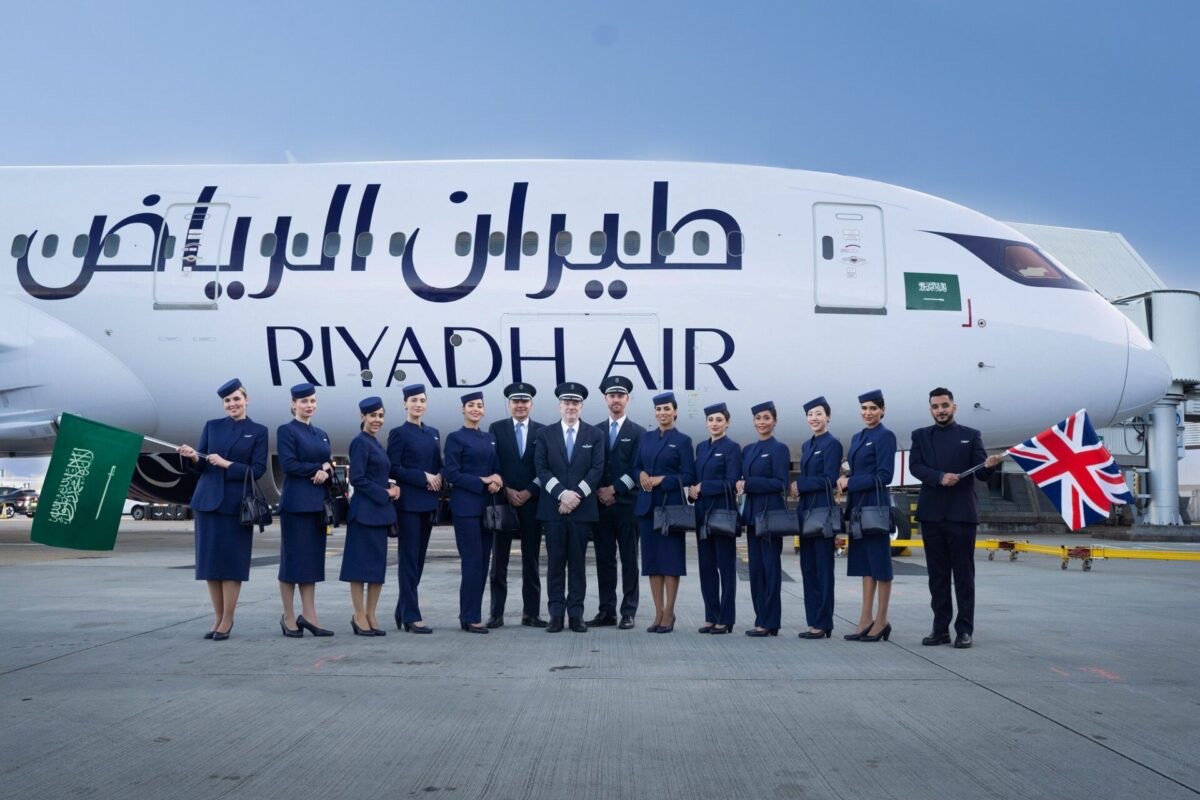
Riyadh Air London Heathrow flights are now open to the general public, with the airline confirming that full-service operations on Boeing 787-9 Dreamliners will begin on 1st July 2026 between Riyadh’s King Khalid International Airport and London Heathrow Terminal 4. Tickets are available from 19th May 2026 via the carrier’s website and app, and through third-party travel platforms.

This is not quite the launch it might appear on the surface. Riyadh Air has actually been flying daily to Heathrow since 26th October 2025, using a leased Oman Air Boeing 787-9 known internally as “Jamila.” Those flights were largely restricted to airline staff and employees of the Public Investment Fund, the sovereign wealth vehicle that backs the carrier. What changes on 1st July is the aircraft: the first customer-configured 787-9, registered HZ-RXAA and reportedly owned by AviLease, was delivered in May 2026 and is the aircraft the public will actually board. Jamila continues to operate until 30th June 2026 and remains bookable through approved travel partners in the interim.
What does the cabin actually look like?
The 787-9 is configured across four classes, carrying 290 passengers in total: four seats in Business Elite, 24 in Business, 39 in Premium Economy and 223 in Economy. Those headline numbers matter. Business Elite, with just four seats, will be exceptionally hard to book in practice. If you are hoping to secure one of those front-row suites with 32-inch screens, a 78-inch flat bed and a sliding privacy door (the centre pair apparently convert into a double bed), you will need to move quickly or accept that availability will be extremely thin on most departures.

Business Class uses Safran Unity seats with fully flat 78-inch beds in a 1-2-1 configuration, and Devialet speakers are embedded in the headrests, which is a genuinely uncommon touch (only seen elsewhere in Japan Airlines).

Premium Economy runs 2-3-2 with privacy headrest wings and four USB-C charging points. Economy is 3-3-3 with a six-way adjustable headrest and two USB-C ports. Across all classes, Bluetooth audio and wired audio jacks are both present.

The in-flight entertainment system is Panasonic Avionics’ Astrova, offering over 500 films and 600 TV series through partners including Shahid (a pan-Arab streaming service), Disney+ and HBO Max, alongside 1,000 audio albums. That is a reasonable library, though whether the catalogue holds up against competitors remains to be seen.

Is the no-alcohol policy a serious commercial problem?
This is the question that many premium cabin travellers on the London route will ask first. Riyadh Air is a dry airline. A spokesperson confirmed to media that alcohol will not be served, in line with Saudi law. That suggests that if the law was amended, that could change. British Airways and Virgin Atlantic no longer service Heathrow to Riyadh which means Riyadh Air only directly competes with Saudia – another dry airline. Other Middle Eastern airlines, such as Emirates or Qatar Airways, do serve alcohol on many routes to non-Islamic countries. For some travellers who consider a glass of wine standard on a long-haul flight, this will be a deciding factor – though certainly not for me.

The airline’s CEO Tony Douglas framed the launch in broad terms, referring to the carrier’s commitment to its “Hafawa” hospitality and what he described as bringing a genuinely premium experience to guests on this corridor. Paraphrasing him, the point he emphasised was that connecting Saudi Arabia and the UK sits at the heart of what the airline is building under Vision 2030. That framing is accurate but also reveals the commercial logic at work here: Riyadh Air’s primary purpose is inbound tourism to Saudi Arabia, not the sixth-freedom connecting traffic that sustains Emirates, Etihad and Qatar Airways. If British leisure travellers do not warm to Saudi Arabia as a destination at scale, the load factors on this route will be tested – and we will likely see them pivot to connecting traffic.
What is the market backdrop that the press release skips over?
Heathrow-to-Middle East passenger traffic fell by more than 50 per cent year-on-year in April 2026, driven by ongoing regional tensions. That is a striking figure and creates something of a paradox for Riyadh Air: there are fewer competing seats from Gulf rivals on the route right now, which could help early load factors, but the underlying demand signal is not encouraging. The release does not address this at all. (Whether traffic recovers by July is genuinely unknowable at the time of writing.)

There is also the matter of Riyadh Air’s delivery timeline. The airline originally planned to start commercial operations before the end of 2024. Boeing production issues, GE Aerospace engine delays and cabin supplier problems collectively pushed that back well over a year. Corporate travel buyers and tour operators with long memories will want to see several months of reliable flying before committing serious volume to the carrier. That is not a criticism unique to Riyadh Air, but it is a reasonable caution when the operational history on public-facing tickets amounts to roughly six weeks before this article is published.

The Emirates parallel from the research brief is worth noting. When Emirates launched London Heathrow services in 1990, it was a state-backed Gulf carrier with a superior hard product entering a route dominated by established incumbents. Within a few years it had forced those incumbents to upgrade. Riyadh Air has the capitalisation, the fleet orders (39 firm 787-9s, plus 25 Airbus A350-1000s and 60 A321neos on order) and the product ambition to follow a similar trajectory. Whether the demand for Saudi Arabia as a destination grows fast enough to support that ambition is a separate question entirely.
Is the Sfeer loyalty programme worth joining now?
The Sfeer programme is genuinely worth a look for early adopters. The headline benefits for Founding Members include a no-expiry points policy, the ability to share tier points with family and friends, complimentary onboard Wi-Fi and priority access to bookings on new routes. The gamified elements (challenges, leaderboards) are clearly aimed at a younger traveller demographic. No pricing for flights has been disclosed publicly at the time of writing, so the “Best Offer Guarantee” for Sfeer members cannot yet be evaluated in practice.

What is notably absent from the programme details released so far is any mention of partner loyalty arrangements. The Gulf carrier model typically leans heavily on airline alliances, hotel or credit card partnerships to give a frequent flyer programme genuine breadth. Emirates Skywards, Etihad Guest and Qatar Airways Privilege Club all allow members to earn and redeem miles across a wide network of partners, which significantly increases the day-to-day utility of holding status. Riyadh Air has not announced any equivalent partnerships for Sfeer at launch, beyond vague press releases about future relationships with airlines such as Virgin, which means the programme’s value is limited to what you earn flying Riyadh Air itself. That may well change as the airline’s network grows, but it is worth factoring in if you are deciding whether to consolidate loyalty spending here rather than with an established programme.

Riyadh Air’s London Heathrow service moves from a restricted soft launch to genuine public availability on 1st July 2026, operated on a configured Boeing 787-9 with a hard product that will interest any premium cabin enthusiast willing to fly dry. For travellers comfortable without alcohol service, the Business and Business Elite cabins represent something meaningfully different on the Heathrow-Riyadh corridor.
Leave a Reply